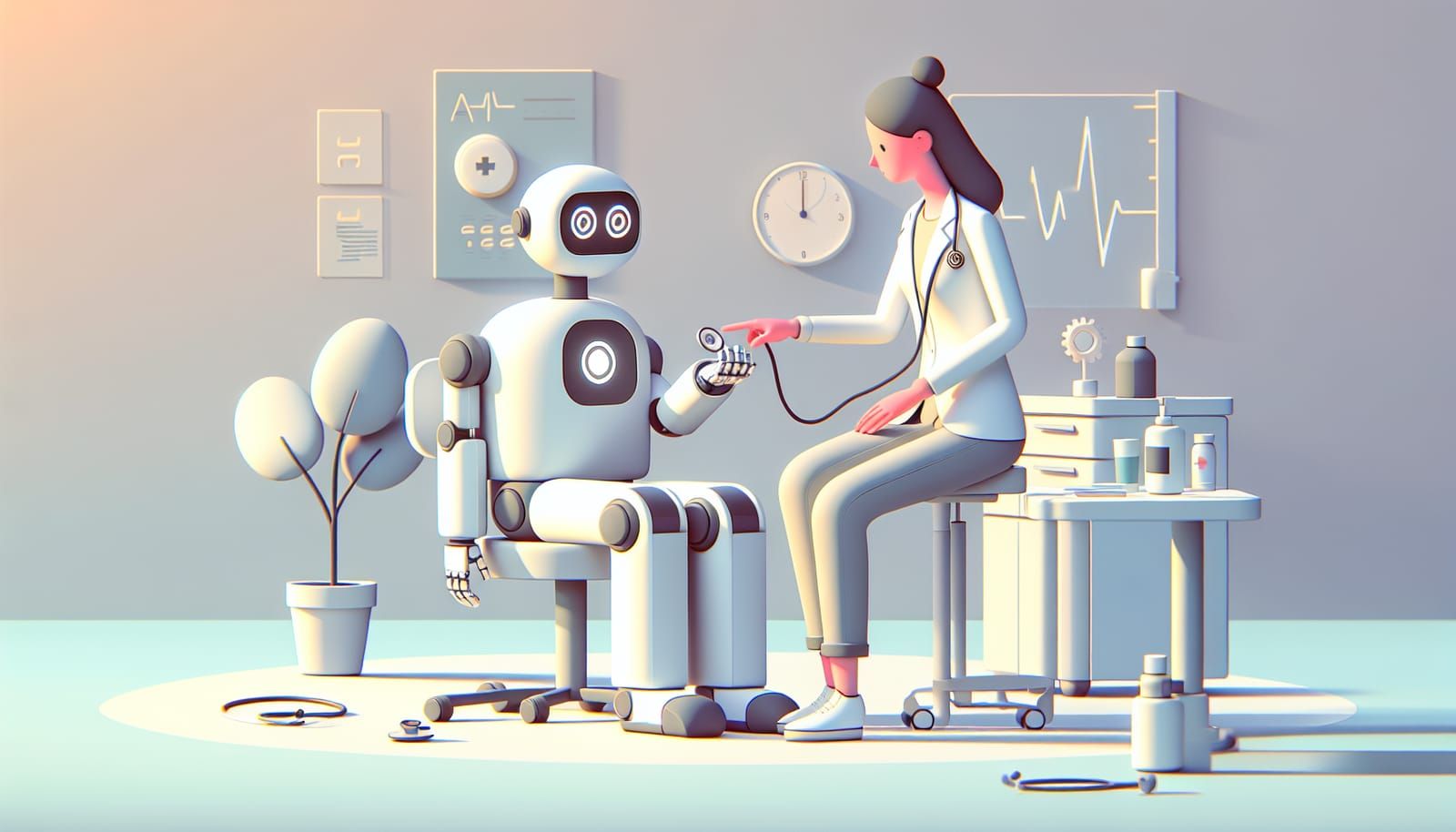
Imagine Teaching a Robot With Make-Believe Practice
What if you could teach a robot to recognize a dog without showing it millions of real dog photos? What if doctors could train medical AI without exposing real patient records? What if a self-driving car could practice dangerous situations—like a child running into the road—without putting anyone in danger?
That is the promise of synthetic data.
Synthetic data is information that is artificially created instead of collected directly from the real world. It can look like photos, videos, voices, text, medical records, driving scenes, factory data, or even financial transactions. But instead of coming from a real camera, real person, or real event, it is made by computers.
In simple words: synthetic data is practice material for AI.
Just like a pilot can train in a flight simulator before flying a real airplane, AI systems can train with synthetic data before working in the real world. This is becoming one of the biggest trends in artificial intelligence because the world needs more data, safer data, and better ways to train smarter machines.
Why AI Needs So Much Data
To understand why synthetic data matters, we first need to understand how many AI systems learn.
AI learns by studying examples. If you want an AI to identify cats, you show it many pictures of cats. If you want it to understand speech, you give it many recordings of people talking. If you want it to help doctors find signs of disease, it may need to study many medical images.
The more good examples an AI sees, the better it can become.
But here is the challenge: real-world data can be hard to get.
Sometimes it is too expensive. Sometimes it is private. Sometimes it is rare. Sometimes it is dangerous to collect. Sometimes it does not include enough examples of unusual situations.
For example, a self-driving car company may collect millions of miles of driving video. But even after all that, it may still have very few examples of rare events, such as:
- A deer jumping across a snowy road at night
- A traffic light not working during a storm
- A bicycle suddenly swerving into traffic
- A person wearing unusual clothing crossing the street
These rare situations matter a lot. AI must learn how to handle them safely. Synthetic data lets developers create those situations in a computer simulation and let the AI practice again and again.
What Synthetic Data Looks Like
Synthetic data can take many forms. It is not just one thing.
A video game-like city used to train self-driving cars is synthetic data. A fake-but-realistic medical scan used for research can be synthetic data. A computer-generated voice used to train a speech system can be synthetic data. A made-up bank transaction used to test fraud detection software can also be synthetic data.
Here are a few common types:
- Synthetic images: Computer-created pictures of people, objects, streets, products, or medical scans
- Synthetic text: Artificially generated sentences, conversations, summaries, or documents
- Synthetic audio: Computer-made voices, sounds, or speech samples
- Synthetic video: Simulated movement, traffic, sports actions, or camera footage
- Synthetic tabular data: Fake rows and columns that look like real business, health, or financial records
The key idea is that synthetic data is designed to be useful for learning, testing, or improving AI systems.
It may be created using computer graphics, rules, simulations, statistical models, or even other AI systems. For example, a company might build a virtual warehouse and create thousands of images of boxes, shelves, robots, and workers. The AI can then learn to recognize items in many lighting conditions and angles before entering a real warehouse.
Why Companies Are Turning to Synthetic Data
Synthetic data is becoming popular because it solves several big problems at once.
First, it can reduce the need for sensitive real-world data. In healthcare, education, banking, and government, data often includes private information. Sharing real patient records or customer details can be risky and heavily regulated. Synthetic data can help researchers and developers test systems while protecting people’s privacy.
Second, synthetic data can help fill gaps. Real datasets may not include enough examples from different age groups, skin tones, languages, locations, weather conditions, or unusual events. If used carefully, synthetic data can help make AI systems more balanced and useful for more people.
Third, synthetic data can be created quickly and at scale. Instead of waiting months to collect certain examples, engineers can generate thousands or millions of variations. They can change the lighting, background, object size, language style, weather, speed, or angle.
Fourth, synthetic data can make testing safer. You would not want to test a drone by making it crash into real buildings. But in a simulation, the drone can crash, learn, and try again.
This is why synthetic data is exciting: it gives AI a kind of “practice playground.”
A Real-World Example: Self-Driving Cars
Self-driving cars are one of the clearest examples of why synthetic data matters.
A self-driving car must understand roads, signs, people, vehicles, animals, weather, and unexpected events. It must do this in real time. That is an enormous challenge.
Real driving data is valuable, but it cannot cover every possible situation. A car might need to know what to do when:
- Fog hides road markings
- A truck drops boxes onto the highway
- A child’s ball rolls into the street
- A construction worker gives hand signals
- Bright sunlight blinds the camera
Some of these events are rare. Some are dangerous. Some are difficult to collect naturally.
With synthetic data, companies can create virtual roads and run thousands of tests. They can make it rain, snow, or turn dark. They can place pedestrians, bikes, emergency vehicles, or roadblocks in the scene. Then they can see how the AI responds.
This does not mean synthetic data replaces real-world testing. Real testing is still important. But synthetic data can help AI learn more safely before it faces real situations.
A Real-World Example: Medicine and Health
Healthcare is another area where synthetic data may be very useful.
Medical AI can help doctors find patterns in X-rays, scans, lab results, and patient histories. But real medical data is extremely sensitive. It belongs to real people, and privacy must be protected.
Synthetic medical data can help researchers build and test tools without exposing private information. For example, synthetic patient records might be used to test hospital software. Synthetic medical images might help train AI to spot signs of disease when there are not enough real examples available.
This could be especially helpful for rare diseases. If only a small number of real cases exist, AI may not have enough examples to learn from. Carefully created synthetic examples can help researchers study possibilities and build better tools.
However, healthcare is also an area where accuracy is critical. Synthetic data must be checked carefully by experts. AI should support doctors, not replace their judgment.
Synthetic Data and Creativity
Synthetic data is not only about cars and hospitals. It is also connected to creativity.
AI systems that create images, music, voices, games, animations, and stories often learn from large amounts of data. Synthetic data can help improve these creative tools by giving them more examples to study or by creating special training situations.
For example, a game studio could use synthetic data to teach AI characters how to move through a fantasy world. A language-learning app could generate practice conversations for students. A filmmaker could use AI-generated backgrounds to test scenes before filming.
This can open doors for people who do not have big budgets or large teams. A young artist, student, teacher, or small business owner may be able to use AI tools to explore ideas faster.
Synthetic data can make AI more flexible, more imaginative, and more accessible.
The Big Benefits
Synthetic data has several important benefits:
Privacy protection
It can reduce the need to use real personal information.Safety
AI can practice dangerous situations in simulations.Speed
Developers can create many examples quickly.Cost savings
Collecting and labeling real data can be expensive.Better coverage
Synthetic data can include rare events and unusual conditions.More testing
AI systems can be tested in many controlled situations.
Think of it like building a giant training gym for AI. Instead of waiting for the real world to provide every lesson, we can create lessons on purpose.
The Challenges We Must Take Seriously
Synthetic data is powerful, but it is not magic. It must be used carefully.
One challenge is quality. If synthetic data is unrealistic or poorly designed, AI may learn the wrong things. Imagine training a robot to recognize apples using fake apples that look nothing like real ones. The robot may fail when it sees an actual apple.
Another challenge is bias. If synthetic data is created from biased real data, it can repeat or even increase those biases. For example, if a face recognition system is trained mostly on one type of face, synthetic data must be designed carefully to include many kinds of people.
There is also a risk called “model collapse” in some AI research discussions. This can happen when AI systems are trained too much on AI-generated material and not enough on high-quality real-world data. Over time, the system may lose accuracy or variety. This is one reason experts often combine synthetic data with real data and careful human review.
Privacy also still matters. Synthetic data is not automatically private just because it is artificial. If it is created poorly, it might accidentally reveal details from real data. Good privacy methods and testing are needed.
So the message is not “synthetic data is perfect.” The message is: synthetic data is useful when it is created, tested, and used responsibly.
How Synthetic Data Could Shape Tomorrow’s AI
In the future, synthetic data may help AI become more helpful in everyday life.
It could help robots learn household tasks before entering real homes. It could help farmers use AI to spot plant diseases earlier. It could help cities test traffic systems. It could help teachers create custom learning tools. It could help scientists explore rare events, from climate patterns to space missions.
Imagine a rescue robot practicing thousands of earthquake scenarios in a virtual city. Imagine an AI tutor learning how to explain math in many different ways. Imagine medical research tools that can be tested safely before being used with real patients.
Synthetic data gives us a way to prepare AI for a wider, richer, and more complicated world.
Why This Matters to Everyone
Even if you are not a programmer, synthetic data matters because AI is becoming part of daily life.
AI may help recommend movies, translate languages, check spelling, protect bank accounts, guide delivery routes, improve farming, support doctors, and power future robots. The data used to train these systems affects how well they work and how fairly they treat people.
If AI is trained on better, safer, more diverse examples, it can become more useful for everyone.
Synthetic data also shows something exciting about human imagination. We are not only teaching machines with the world as it is. We are building practice worlds to help machines prepare for what could happen.
That is a big idea.
It means AI development is moving beyond simply collecting information. It is becoming more like designing lessons, building simulations, and creating safe spaces for learning.
The Future Is Built With Smart Practice
Synthetic data is one of the most important trends in AI because it helps answer a simple question: How can we teach AI well when real-world data is limited, private, rare, or risky?
The answer is not to use fake information carelessly. The answer is to create high-quality artificial examples that help AI learn safely and responsibly.
Like a student using practice problems, a pilot using a simulator, or an athlete training before a big game, AI needs practice too. Synthetic data provides that practice.
Tomorrow’s AI may drive cars, help doctors, support teachers, protect wildlife, improve science, and make creative tools more powerful. Synthetic data is one of the building blocks helping that future arrive.
And the best part? This future is not just about machines getting smarter. It is about people finding smarter, safer, and more creative ways to solve problems.
Synthetic data may be artificial, but its impact on the real world could be very real.